

When I was a kid, castles were serious business.
Holiday trips had to feature enough piles of crumbling stone to keep me and my brother compliant with the rest of my parents plans. Over time, I became a castle connoisseur with a distinct taste for what makes a cool castle, and being the judgemental kid I was, even more importantly a taste for what defines a shitty castle. In a nutshell, a castle had lost its justification for existence when it was not gritty enough. As I grew older, my judgement became more subtle and I realized that what disqualified castles the most were castles not meant to defend anything, but only to resemble actual fortifications. 10-year-old me enjoyed a good fortress and hated the chateau. Every time I ended up disappointed in a 19th century palace villa with skinny walls that would fall faster to a battering ram than dark age palisades I wondered: Why would you build a castle that is not a castle?
In 1676, Leibniz discretely visited the infamous Spinoza in his modest workshop, where he maintained a humble business of grinding lenses. Leibniz was eager to meet the man that had published the most radical ideas of his time, considered so dangerous that it got Spinoza expelled with colourful words1 from his religious community and led him to spend the rest of his life in the intellectual underground.
At the core of Spinoza’s thinking lay a disruptive argument: because a truly infinite God must encompass all reality, nothing can exist outside of him. Therefore, Spinoza argued that God and Nature had to be the same thing. This idea was destined to drive a powerful wedge into the rigid belief systems of 17th century European philosophy. If God is not the guy with a beard watching and judging us from a cloud but some abstract omnipresent quality, who would let hellfire rain on sinners and atheists?
Although little is known about the short meeting of Leibniz and Spinoza, it seems that Leibniz was impressed and unsettled by the ideas of his fellow thinker. After Spinoza’s early death though, Leibniz increasingly positioned himself as an opponent to Spinoza. Eventually he proposed the idea that everything was built from an infinite number of tiny “Monad” units, each of them containing its own tiny immortal soul which still had to fear hellfire from above. In public, Leibniz claimed the monads were designed to defeat Spinoza’s radical findings.2 Yet many assumed that actually, Leibniz understood his counter-theory was not strong enough to resist the ideas Spinoza had brought into the world.3 It seems Leibniz completed his complex theory of Monads whilst knowing it would not stand the test of time against the rising secularism.
Leibniz probably was frightened by the implications of Spinoza’s theory. He worried that mankind would lose the capability to care about anything, if God would be reduced to a depersonalized background quality. Beyond spiritual concerns though, Leibniz seems to have been driven by very practical implications. Openly supporting Spinoza was toxic for 17th century careerists like Leibniz, who despite becoming ever more wealthy, was always concerned about his economic security.4 It is tempting to dunk on Leibniz for being an opportunist first making friends with a humble guy like Spinoza and later posthumously denouncing him. 10-year-old me wants to put him in a box labeled “Hypocrites”, right next to Robert the Bruce who sits there since 1995 for betraying Mel Gibson in Braveheart.
But there may be more ways to look at it. Learning about the Monads of Leibniz I wondered: why would you come up with an intellectual system that is not really defending anything? Why dig a moat around your position, when you already know it will not slow down anyone or anything?
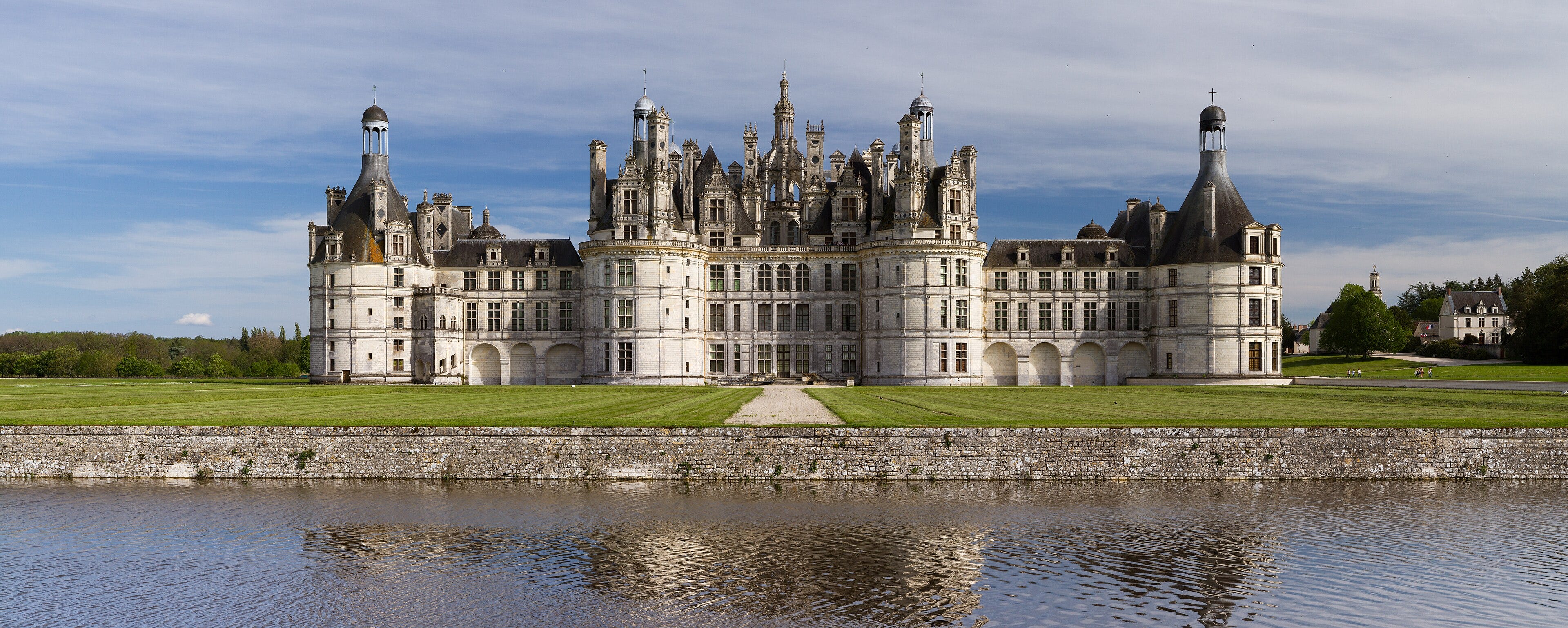
In 1519, King Francois I of France started building his famous castle of Chambord, but had to interrupt the project a few years later for a war with the Italians. During the famous 1525 battle of Pavia, Francois made a bad decision by charging ahead with his medieval lance riders in full Braveheart mode, first blocking his own artillery and shortly after being trapped by Pikemen and Arquebusiers, captured subsequently. Underestimating gunpowder units like that is a rookie mistake in Age of Empires 2 and you would assume Francois learned his lesson. Interestingly though, when the french king could return home a year later, the works on Chambord continued as before. 1800 workers were moving 220.000 tons of Stone5 to build a huge castle despite the sponsor of the project just had been defeated by weapons that would crunch these feeble walls surrounded by a fake moat in minutes.
In 2023 the famous “There is no Moat” memo6 leaked from Google and started a discussion in the booming AI industry about how long proprietary frontier models would remain competitive against open source competitors. Since the release of the memo, a growing ecosystem of mostly chinese open source models is rapidly closing performance gaps to the market leaders, while these cheaper alternatives are being adopted globally.7 In May 2025, some months after the cheap but powerful chinese model DeepSeek R1 launched with global acclaim, OpenAI announced its acquisition of “io”, the company of Ex-Apple Design Chief’s Jony Ive for 6.5 billion dollars. In a cringy YouTube video, Sam Altman and Jony Ive exchanged courtesies over a coffee, vaguely pointing to an AI-native personal gadget they would built together. Almost a year later, not much is heard of this cooperation but news on a lost trademark lawsuit about the brand name “io”. The whole move seems expensive, complicated and somehow bound to fail from the beginning, considering how badly all other attempts in this product category had been doing so far.
Once you see the pattern of “elaborate defences built by people who know they won’t hold” it’s hard to not see them everywhere. Why would you spend years refining a complicated philosophical framework you know to be flawed from the very beginning? Why would you build a shitty castle with a fake moat? Why perform a big pivot to hardware if dedicated AI gadgets have proven to be a thing nobody wants?
A more generous read of Leibniz could consider the Monad system not as a self deceiving, hypocritical move against his own convictions, but a pragmatic strategy to secure his economic and political base in a climate that shifted against him. Given his anxiety for material security, Leibniz could not have joined the Spinozists in their intellectual rebellion, but had to stay aligned with the rich donors that financed his career.
In the case of Chambord, the castles official website proposes an explanation: It was never meant to be an actual fortress, but a symbol of the Kings attachment to the disappearing era of Chivalry.8 Now this might be considered merely an expensive expression of nostalgia, but I think there is more to it. Spending immense amounts of effort into a complex thing is in itself a demonstration of power and Chambord seems to have worked this way for the french king. In 1539, while the castle was still under construction, Francois invited Charles V of Italy, the very king that had captured him in Pavia, for a diplomatic exchange. Workers had to scramble to finish the sleeping quarters for the Italians, but the effort seems to have been worth it, as Charles V is cited praising Chambord as “a synthesis of all that human effort can achieve”.9 While Chambord obviously is the quintessential shitty castle of my youth, it may have served its purpose as a tool of power and propaganda when gunpowder technology transformed military tactics in hard to predict ways.
Burning billions with acquiring a small design company may have been a smart move for OpenAI at a moment when the markets were expecting a new strategic direction to justify a 500 billion dollar evaluation until then only based on a chatbot, an API and the buttery voice of Sam Altman. Acquiring the most famous product designer alive and commiting towards developing some kind of new hardware platform may just have been a convincing enough signal for investors, even if the actual device they ship would fail in similar ways as previous attempts in this domain.
A part of me wants to dispel Leibniz, but the more I think about it, the more it seems this kind of judgement just carries as much hypocrisy as its target. A lot of people, myself included, would like to be as straight-forward in their decisions as Spinoza. Yet we end up maneuvering like Leibniz. I think with some of my past writing I have been digging fake moats for myself. I wrote some fancy essays while deep inside I knew they would not withstand the contact with reality, in particular the honest critique of my smartest friends.
Why? Maybe because having something to hold on to feels better than facing the eternal indifference of the universe the online sphere empty handed. The smarter move is probably to stay with the discomfort of not knowing,10 observe and wait until a truly solid idea comes along. But man, that’s hard to pull off.
Today, Chambord is a buzzing tourist site in France, the fragile philosophy of Leibniz has been famously ridiculed in Voltaire’s Candide and the mysterious device OpenAI may release in the near future has already become a target of online humor and fake Superbowl ads.11 Seeing others assemble complex things bound to fail is entertaining and relatable, because scrambling to get by is a human necessity. This may be why defunct moats earn their place in the heart of pop culture.
So why would you build a castle that is not a castle? To use the power you still have to create something fancy that is good enough to keep yourself sane until you have a better idea.
P.S.:
As Venkatesh Rao lays out in the foundations of his 2026 Book Club (which led me to read about Leibniz & Spinoza in the first place), Late Modernity is populated by “energetic zombies”12 haunting the present with ideas from the past. The Monads, Chambord Castle and maybe soon the weird video of Sam Altman and Jony Ive drinking coffee in San Francisco may be considered zombie ideas in their time, but sometimes it is hard to tell. How to separate the zombies from ideas worth interacting with?
It could help to become a connoisseur of moats. A 13th century moat had honest functional value. A 16th century moat, like the one surrounding Chambord, maintained performative value as a demonstration of power. The moat surrounding 19th century Neuschwanstein (the castle on the Disney Logo) was purely ornamental, designed to please its eccentric sponsor Ludwig 2nd of Bavaria. The King of Swamp Castle in Monty Pythons 1975 “The Holy Grail” ridiculed the idea of moat fortifications entirely.13 In the same way actual moats progressed from a serious statement to performance, to decoration and eventually ridicule other ideas and frameworks may move through similar cycles, recycled by time with decreasing relevance for the actual course of history. The more functional flaws you find, the more likely you are facing a dead facade, not a working fortification.
“Cursed be he by day and cursed be he by night; cursed be he when he lies down and cursed be he when he rises up. Cursed be he when he goes out and cursed be he when he comes in. The Lord will not spare him, but then the anger of the Lord and his jealousy shall smoke against that man, and all the curses that are written in this book shall lie upon him, and the Lord shall blot out his name from under Heaven.” The Courtier and the Heretic: Leibniz, Spinoza & the Fate of God in the Modern World (Matthew Stewart)
Leibnitz on Spinoza: “On the contrary, it is precisely by means of the monads that Spinozism is destroyed.” The Courtier and the Heretic: Leibniz, Spinoza & the Fate of God in the Modern World (Matthew Stewart)
For example, Lessing suspected that Leibniz actually was “a Spinozist by heart” . Later Bertrand Russel stated that “Leibniz fell into Spinozism whenever he allowed himself to be logical; in his published works, accordingly, he took care to be illogical”. The Courtier and the Heretic: Leibniz, Spinoza & the Fate of God in the Modern World (Matthew Stewart)
Leibniz to Antoine Arnault: “There is nothing, I think, upon which I have brooded more earnestly over the course of my life, however short, than the problem of assuring my security in the future, and I confess that by far the greatest cause of my philosophizing as well has been the hope of winning a prize not to be disdained—peace of mind—and the ability to say that I have demonstrated certain things which have heretofore merely been believed or even, in spite of their great importance, ignored.” The Courtier and the Heretic: Leibniz, Spinoza & the Fate of God in the Modern World (Matthew Stewart)
see the french wikipedia for details on Chambord
“The adoption of Chinese models is picking up in Silicon Valley, too. (...) Among startups pitching with open-source stacks, there’s about an 80% chance they’re running on Chinese open models (...). Z.ai limited new subscriptions (...) after demand surged, citing compute constraints. What’s notable is where the demand is coming from: CNBC reports that the system’s user base is primarily concentrated in the United States and China, followed by India, Japan, Brazil, and the UK.” MIT Technology Review on the state of Chinese AI Models in 2026
“Take a close look at the keep, at its corner towers, its enclosure, its moats with their water, and you will see them bringing back to life a form of military power that may no longer be real, and is emphatically allegorical. More than thirty years after the construction of the last fortified castles was completed, these features serve as unmistakable architectural citations of bygone times. In the eyes of the contemporaries of François I, they conjure up recollections of a declining universe of chivalry, universe to which the young sovereign, who was the last chevalier king, remained nostalgically attached.” The official Chambord website on the castles architecture
Henrik Karlsson compares this to being lost in the woods: “If you’re clenching and panicking and needing to get out of the woods now, it’s going to be a terrible experience. If you’re instead thinking, ‘I guess I’m in the woods. I don’t really know where I am, but it’s kind of beautiful here,’ you can stroll around and notice things.” Henrik Karlsson on the Dialectic Podcast with Jackson Dahl (Episode 41)
This term is taken from Venkatesh Rao: “Arguably, the bulk of the energy of the world will continue to flow through late-modern pathways for at least our lifetimes, even if very little of the evolutionary intelligence of the world flows through those pathways (hence “zombie” or perhaps “energetic zombie” would be a better term, like the ones in the Korean movie, Train to Busan).” The Divergence Machine (Venkatesh Rao)
“Everyone said I was daft to build a castle on a swamp, but I built in all the same, just to show them. It sank into the swamp. So I built a second one. That sank into the swamp. So I built a third. That burned down, fell over, then sank into the swamp. But the fourth one stayed up.” Quote from Monty Pythons The Holy Grail (IMDB)
Leibniz wasn’t just a careerist. Spinoza has a huge issue where his substance punts on how it maintains its direction in its mildly opaque phase space. Conatus is a cheat code for describing processual units in a block universe.
At least monads were honest that if a dynamical system is to achieve the perfection of god, we may as well assume it to be built in from the start.
It is a shame both thinkers weren’t alive in the late 20th century, as complexity theory and emergence would have given them at least some room to move.
Enjoyed it! Especially interrogating the word moat from different angles. And I like your personal perspective, particularly your takes on what makes castles good versus shitty.